
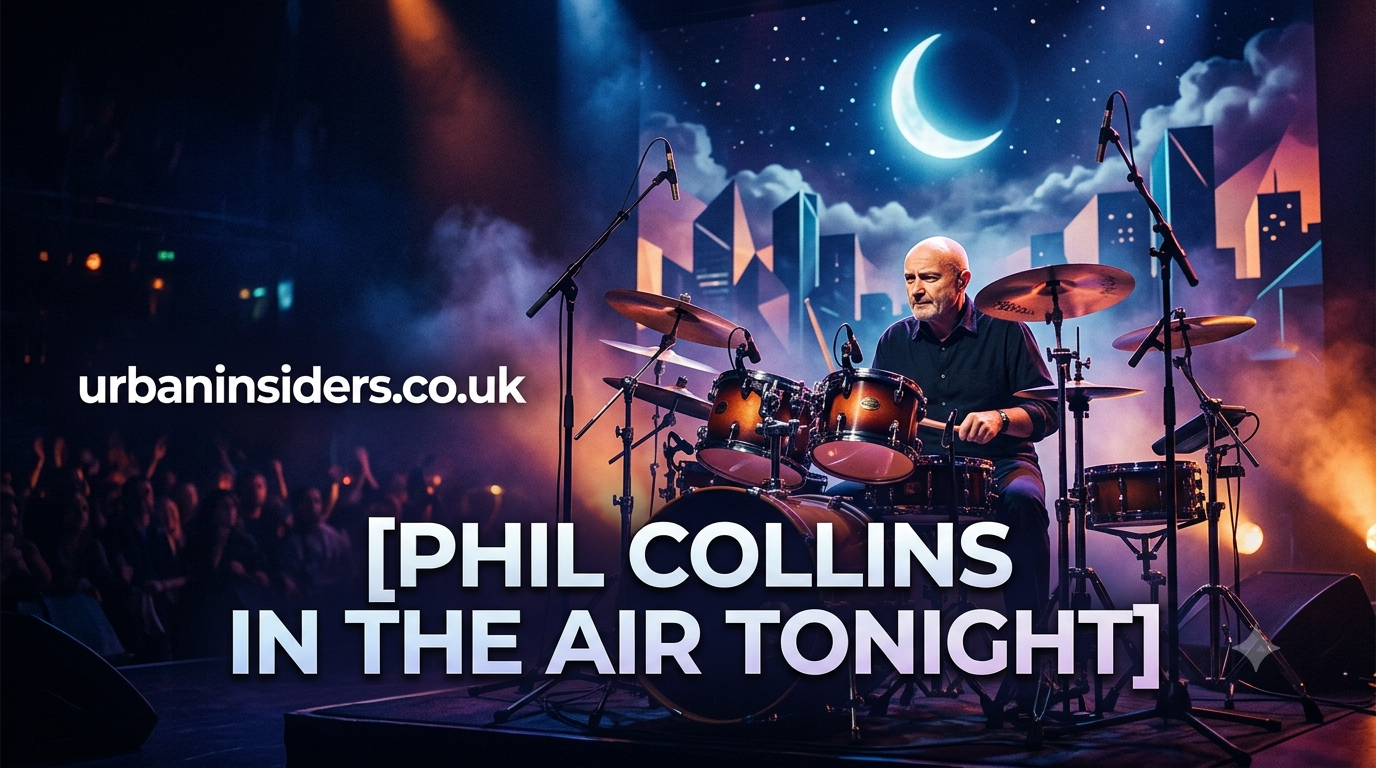
Few songs have a backstory as widely misunderstood as Phil Collins’ “In the Air Tonight.” For over four decades, people have sworn the song describes a drowning Collins supposedly witnessed and later avenged from the stage. That story is false, and Phil collins in the air tonight has said so directly, more than once. What actually happened is quieter, sadder, and arguably more interesting: a musician working through the end of his marriage, recording almost by accident, in a room that happened to make drums sound like nothing anyone had heard before.
This guide covers what the song is really about, how the drum break came to exist, why the myth spread so far, and where the track shows up today, from Monday Night Football to a Jake Paul entrance walk.
What “In the Air Tonight” Is Actually About

Phil collins in the air tonight wrote the song in 1979 and 1980 while going through his divorce from his first wife, Andrea Bertorelli. He has described the lyrics as coming out of anger and frustration during that period rather than any single event. In a 2016 interview, he said he wasn’t entirely sure what the song meant even to him, only that it carried a lot of anger, despair, and frustration from that time in his life.
That uncertainty is part of what makes “Phil collins in the air tonight” different from a typical breakup song. The lyrics read like an accusation aimed at someone specific, but Phil collins in the air tonightnever named who, and by his own account he wrote most of the words in one spontaneous take while playing around with chords in the studio. He wasn’t building toward a tidy narrative. He was venting.
Phil collins in the air tonight originally played the song for his Genesis bandmates, Mike Rutherford and Tony Banks, but it didn’t make the cut for the band’s material. He later said it felt “too simple” for Genesis, which is part of why it ended up as the opening track on his debut solo album instead.
Read more: Roger Federer: Career, Records, Net Worth, and Life After Tennis in 2026
The Urban Legend That Refuses to Die
The most persistent story about “Phil collins in the air tonight” goes something like this: Collins witnessed a man drown while another man stood close enough to help but did nothing. Years later, the story goes, Collins tracked the bystander down, invited him to a concert, sat him in the front row, and sang the song directly at him before he was arrested.
Every part of that story is fictional. There are dozens of variations, some involving a boat capsizing, others turning the drowning victim into a rape survivor and the bystander into an attacker. Phil collins in the air tonightthey share is a dramatic structure that the actual lyrics only loosely support: an early line about not lending a hand to someone who claimed they were drowning, paired with lines about having seen what someone did, gave listeners enough raw material to build an entire crime story around.
Collins addressed the myth directly in a BBC World Service interview, saying he didn’t know what the song was about beyond it being tied to anger from his divorce, and that he found it strange how the drowning story kept getting more elaborate the more times he heard it repeated back to him, particularly in the United States. He gave the same answer when Jimmy Fallon asked him about it on The Tonight Show in 2016, calling it a great story but confirming it had nothing to do with how the song was written.
The legend became famous enough that Eminem referenced it in his 2000 song “Stan,” describing the drowning story almost exactly as it circulated at the time. That single reference introduced the myth to a new generation of listeners who had never heard the original tale, which helped keep it alive well into the streaming era.
How the Song Was Written and Recorded
Musically, “Phil collins in the air tonight” is built on a Roland CR-78 drum machine pattern, a Prophet-5 synthesizer playing a repeating chord progression, a Rhodes electric piano, and vocals processed through a Roland VP-330 vocoder on certain key words to add atmosphere. The song is in D minor at a moderate 96 beats per minute, and for nearly four minutes it stays restrained: no live drum kit, no release, just a slow build of tension.
Phil collins in the air tonight has said he bought the drum machine specifically because he needed a way to work through what he was feeling by writing music, and that the lyrics arrived almost fully formed as he sang along to the chords he liked. He has called that spontaneity both a little unsettling and something he’s genuinely proud of.
The Story Behind That Famous Drum Fill
The song’s real signature isn’t the verses, it’s the moment near the four-minute mark when the drum machine gives way to a live, thunderous drum break. That sound exists because of a recording accident that happened a year earlier, on a different artist’s album.
In 1979, while engineer Hugh Padgham was working on Peter Gabriel’s third solo album, phil collins in the air tonight was in the studio playing drums without cymbals, at Gabriel’s request. A talkback microphone meant only for the engineers to communicate with musicians in the room was left open above the drum kit. That mic ran through a heavy compressor and one of the console’s noise gates, and the combination produced a huge, punchy sound that cut off abruptly instead of trailing away naturally. Gabriel built his track “Intruder” around the effect, and the technique later became known as gated reverb.
A year on, Padgham was brought in to co-produce Collins’ solo material, and the two of them recreated the effect deliberately in Townhouse Studios’ Stone Room, a live room built from stone to sound like the interior of a castle. That’s where the drum break on “In the Air Tonight” was recorded. Padgham has described the moment everyone in the control room first heard the finished sound as something close to disbelief.
The U.S. single version also has extra drumming woven in earlier than the album version. According to Collins’ own account, Atlantic Records co-founder Ahmet Ertegun heard the final mix and pushed back on how long listeners had to wait for a beat to come in, so drums were added under the earlier verses for the American single release.
Musicians have singled the fill out for decades. Ozzy Osbourne has called it the best drum fill ever recorded. Broadcaster Stuart Maconie has pointed out that almost nothing happens in the song musically until that moment, which is exactly what makes the payoff land.
Chart Performance and Commercial Success
“Phil collins in the air tonight” was released as a single on 9 January 1981, ahead of Collins’ debut solo album, Face Value, which followed on 13 February 1981. It became the album’s biggest hit and reached number one in Austria, Sweden, Switzerland, and West Germany, though it topped out at number 2 in Collins’ home market, the UK.
| Market | Peak Chart Position |
|---|---|
| UK Singles Chart | No. 2 |
| US Billboard Hot 100 | No. 19 |
| US Mainstream Rock Tracks | No. 2 |
| Canada | No. 2 |
| Austria, Sweden, Switzerland, West Germany | No. 1 |
| New Zealand | No. 2 |
The single was later certified Gold by the RIAA, representing 500,000 copies sold in the US, and the accompanying music video earned a Grammy nomination for Best Video, Short Form in 1985. Face Value itself went on to sell around five million copies in the United States alone and was certified multi-platinum in the UK and Canada.
How the Song Became a Pop-Culture Fixture
The song’s reach has grown well beyond its original chart run, largely through film, television, and, more recently, social media.
Miami Vice (1984). The song appeared in the pilot episode of the crime drama, in a scene widely credited with cementing its association with moody, cinematic driving montages. Critic Matt Zoller Seitz has argued the placement was so effective that the track has rarely been used elsewhere on screen since, because it reads as “property” of the show’s aesthetic.
Risky Business (1983). The song is also known for its use in this film, though its exact scene placement has been debated by fans over the years.
The Cadbury Gorilla advert (2007). A UK commercial featuring a man in a gorilla suit drumming along to the song’s fill became a cultural moment in its own right and pushed the single back into the UK top 20, more than 25 years after its original release. Collins called the advert “fantastic” when asked about it.
The Hangover (2009). A cameo from Mike Tyson performing the drum fill in the film introduced the song to a new generation of moviegoers, and Rolling Stone has credited that scene with taking the fill’s pop-culture status to another level entirely.
TikTok and streaming (2020). A reaction video from the channel TwinsthenewTrend, in which two young listeners heard the song for the first time, went viral and pushed the original recording back onto Billboard’s Digital Song Sales chart at number 3 that August, decades after its release.
Sports and live events. Since the 2023 NFL season, a cover by Chris Stapleton, Snoop Dogg, and Cindy Blackman Santana, with lyrics rewritten weekly to reference the competing teams, has opened every Monday Night Football broadcast. In November 2024, the original recording played as Jake Paul’s entrance music ahead of his fight against Mike Tyson.
Covers and Reinterpretations
The song has been reworked often enough to become something of a genre exercise in itself. Lil’ Kim recorded “In the Air Tonite” with Collins in 2001 for a tribute album. Miami rock band Nonpoint covered it for the 2006 Miami Vice film. In This Moment included a version on their 2017 album Ritual. Marilyn Manson released a gothic, distortion-heavy cover in 2025 that sold out its limited CD pressing within hours and charted on several Billboard rock rankings. Each version keeps the drum break largely intact, which says something about how central that single moment is to the song’s identity.
FAQs
Is “phil collins in the air tonight” really about someone drowning?
No. That story is an urban legend that Collins has denied repeatedly, including on The Tonight Show and in a BBC World Service interview. The song is about the anger and frustration he felt during his divorce, not a specific witnessed event.
What is the song actually about, then?
By Collins’ own account, it’s a spontaneous, angry piece of writing tied to the breakup of his first marriage. He has said he isn’t entirely certain what every line means, only that it reflects real emotion from that period.
What creates the song’s famous drum sound?
A studio effect called gated reverb, discovered by accident a year earlier during the recording of Peter Gabriel’s third album. Engineer Hugh Padgham recreated the sound deliberately for “In the Air Tonight” in a stone-walled live room at Townhouse Studios.
Did Phil Collins really improvise the lyrics on the spot?
Yes, according to Collins himself. He has said he wrote almost all of the lyrics spontaneously while playing chords he liked, without planning out a story in advance.
Why is the song associated with Miami Vice?
Its use in the show’s 1984 pilot episode was memorable enough that the association has stuck for decades, to the point that later filmmakers have largely avoided using the song to prevent it from evoking that show specifically.
Who else has covered “phil collins in the air tonight”?
Notable covers include Lil’ Kim (2001, featuring Collins), Nonpoint (2006), In This Moment (2017), and Marilyn Manson (2025), plus a rotating weekly version by Chris Stapleton, Snoop Dogg, and Cindy Blackman Santana used as the Monday Night Football theme since 2023.
Key Takeaways
- “phil collins in the air tonight” was written during Collins’ divorce from Andrea Bertorelli, not in response to any drowning incident.
- The famous drum fill exists because of an accidental studio discovery a year earlier on Peter Gabriel’s third album, later recreated deliberately by engineer Hugh Padgham.
- The song peaked at No. 2 in the UK and No. 19 in the US on original release, and has re-entered the charts multiple times since, including a 2020 streaming resurgence.
- Its association with Miami Vice, a 2007 Cadbury advert, and The Hangover has kept the drum break culturally relevant across generations who weren’t alive for its 1981 release.
Conclusion
“phil collins in the air tonight” endures for a reason that has nothing to do with the drowning myth built up around it. It’s a song about real anger, recorded almost by accident in a room that happened to make drums sound enormous, and it pays off a four-minute wait with one of the most recognizable moments in recorded music. The true story is less cinematic than the legend, but it’s the one Collins has stood by consistently for over forty years.