
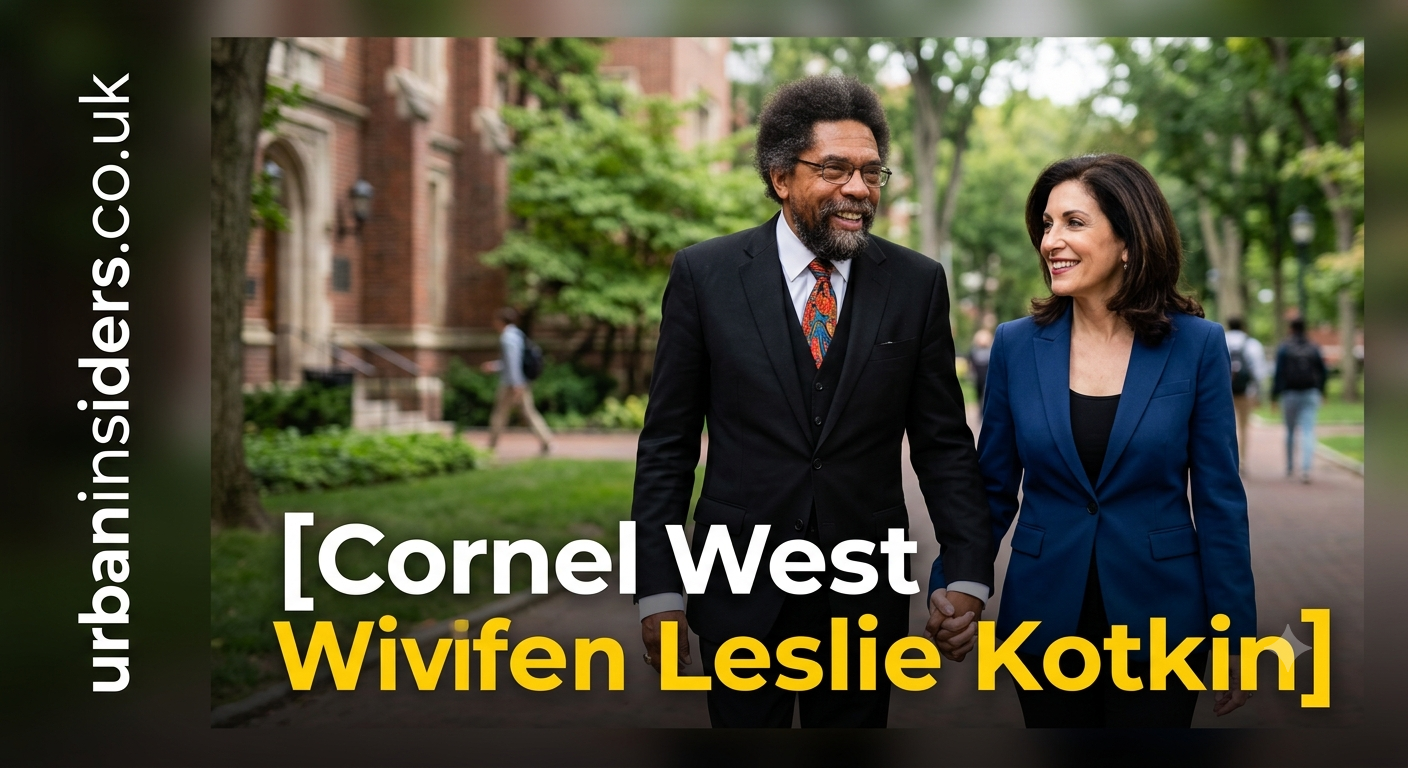
Cornel West Wife Leslie Kotkin life and work have been widely documented and discussed across academic literature, media commentary, and cultural analysis for decades. What remains far less understood, however, is the personal life of his former wife, Leslie Kotkin. Kotkin has no significant public presence outside of her marriage to West, and available information about her background, career, and personal history is extremely limited. Yet her connection to a figure as globally recognized as Cornel West invites curiosity, not just about her identity, but about the dynamics of privacy and personal identity when linked to public intellectualism. In this article, we explore what is known about Leslie Kotkin and weave that narrative into the broader context of Cornel West’s life, scholarly work, family history, and the philosophical values he embodies.
As we examine Kotkin’s place in West’s biography, it is important to clarify what information is verifiable and what remains private or unconfirmed. There has never been a major profile, interview, or public statement from Kotkin herself, nor is there any reliable public record of her early life, education, or professional pursuits. This lack of public documentation shapes her story not as a figure of notoriety, but as a private individual whose life briefly intersected with one of the most significant contemporary philosophers of the 21st century. By situating her story within the broader tapestry of West’s intellectual legacy, we can better understand why some figures remain intentionally outside the spotlight, even while others occupy it so prominently.
The Life of Cornel West: Context for Understanding Kotkin
To understand why Leslie Kotkin’s marriage to Cornel West draws interest, it helps first to understand who West is and what he represents in American intellectual and cultural life. Cornel Ronald West was born on June 2, 1953, in Tulsa, Oklahoma, and raised in Sacramento, California. From an early age, West exhibited a profound engagement with ideas, ethics, and social justice. He pursued his education with rigor, graduating magna cum laude from Harvard University and later earning his doctorate from Princeton University. His academic career would take him to the faculties of Yale, Harvard, Princeton, and Union Theological Seminary, among others.
West is best known for his writing on race, democracy, religion, and power. His book Race Matters, first published in 1993, remains a cornerstone in discussions of race relations and American society. His intellectual voice combines philosophy, theology, history, and personal reflection in ways that resonate with scholars, activists, and lay readers alike. Over the years, West has become not just an academic, but a public intellectual whose influence extends into media appearances, lectures, panel discussions, and cultural collaborations. His work situates him among figures who do not simply comment on society but attempt to transform it through moral and political critique.
Cornel West’s Marital History
Cornel West’s personal life has included a number of intimate relationships that have intersected with different phases of his career. The marriage to Leslie Kotkin was not his first nor his last; it was part of a broader relational history that reflects both the demands of public life and the complexities of personal commitment. Before Kotkin, West was married to Hilda Holloman, with whom he had his first child, Clifton West III. This early marriage occurred during West’s formative years as a young academic.
West’s subsequent marriages included unions with Ramona Santiago and Elleni Gebre Amlak. Each relationship occurred during different professional eras of West’s life, illustrating how personal commitments often shaped, constrained, or complemented his intellectual journey. With his children from earlier relationships, West has maintained a family life that coexists with his public career, though like his marriage to Kotkin, many of these personal moments remain more private than public. The fact that his marital history is part of official biographies without intrusive detail speaks to the balance he strikes between his influential public role and his private family identity.
Who Is Leslie Kotkin?
When asked “Who is Leslie Kotkin?” the straightforward answer is that she is best known for being the former wife of Cornel West. Public records, media commentary, and academic bibliographies contain only sparse references to her outside of this identity. There is no easily accessible documentation of her upbringing, educational background, professional life, or personal pursuits. She did not maintain a public-facing digital presence in the era of social media, nor has she given interviews to established media outlets about her life either before or after her marriage to West.
This cornel-west-wife-leslie-kotkin
of public information may strike some readers as unusual, especially given how the spouses of public figures are often subject to intense media scrutiny. But Kotkin’s story underscores an important cultural truth: not every individual whose life intersects with fame chooses to become part of the narrative. Her decision to remain private, whether intentional or circumstantial, stands in stark contrast to the otherwise highly visible world of academe, media discourse, and cultural influence in which West operates.
The Marriage of Cornel West and Leslie Kotkin
Cornel West and Leslie Kotkin were married in the mid-2010s.Cornel West Wife Leslie Kotkin
the exact private details of their wedding have not been broadly publicized, reputable biographical sources place their marriage between 2016 and 2018. This period represents a later phase in West’s life as an established intellectual figure. Their union was brief, and there are no widely documented accounts of them having children together.
During their marriage, Kotkin did not accompany West to many public engagements, nor did she become a recognizable presence in academic or media circles. This absence of visibility was not interpreted as estrangement, but rather as consistent with her overall pattern of privacy. At the time,Cornel West Wife Leslie Kotkin
was engaged in significant public discourse around American democracy and social justice, and any impact that the relationship may have had on his work remains unquantified in public records. Their divorce in 2018 was reported without controversy, reflecting a mutual decision that remained personal rather than public.
Why Leslie Kotkin Remains Private
Understanding why someone would remain Cornel West Wife Leslie Kotkin
in the age of digital exposure requires thoughtfulness rather than speculation. Not everyone connected to a public figure desires or welcomes attention. Cornel West Wife Leslie Kotkin life story, as far as the public record allows us to discern, is an example of how individuals navigate privacy differently. Some choose the spotlight, as Cornel West has through his books, lectures, documentaries, and frequent media appearances. Others choose to exist outside of it.
Cornel West Wife Leslie Kotkin absence from interviews, social platforms, or professional biographies is not evidence of insignificance. Rather, it reflects an intentional or circumstantial retreat from the public role that often accompanies relational linkage to someone prominent. Cornel West Wife Leslie Kotkin low profile reminds us that public life and private identity are not always coherent or aligned, even when two people share marriage or personal history. In this sense, Kotkin’s privacy is not merely an absence of information; it is a distinct form of personal agency.
The Broader Themes: Privacy, Public Figures, and Identity
The story of Cornel West’s marriage to Cornel West Wife Leslie Kotkin invites reflection on broader themes that extend beyond individual biography. In a media environment that frequently conflates personal life with public persona, Kotkin’s narrative highlights the question of how privacy is preserved in an era of pervasive documentation and digital tracing. For scholars, cultural critics, and readers,Cornel West Wife Leslie Kotkin
becomes important to distinguish between public relevance and personal visibility.
Public figures like West often cultivate a degree of transparency in their lives because their work intersects with social movements, academic debates, and cultural conversations. West’s intellectual contributions are inherently public, concerned with the moral and political beings of society at large. But his marriage to Kotkin points to the fact that not all relationships connected to public figures are themselves public. The contrast between West’s visibility and Cornel West Wife Leslie Kotkin
anonymity underscores the reality that individuals engaged with the public sphere do not always bring their personal partners into that sphere.
This distinction encourages a more empathetic understanding of how people navigate fame by making selective choices about what aspects of their lives are public and what remains private. It also reminds readers that lack of public information is not a lack of value or significance—only a different orientation toward life and public engagement.
Cornel West’s Life After His Marriage to Leslie Kotkin
After his divorce from Leslie Kotkin, Cornel West continued to expand his presence in public discourse. He returned to full‑time roles in teaching, Cornel West Wife Leslie Kotkin
and writing, and remained active in national conversations on political transformation, racial justice, and Cornel West Wife Leslie Kotkin
democratic practice. West’s career after 2018 saw him reinforcing his role as a commentator on American society, authoring books, participating in cultural productions, and engaging audiences through lectures and events.
While the personal details of West’s life after the divorce are not exhaustively documented, it is clear that his professional momentum continued unabated.Cornel West Wife Leslie Kotkin
Cornel West Wife Leslie Kotkin
experiences, including his relational history, are often woven indirectly into his reflections on community, love, struggle, and identity, but he rarely Cornel West Wife Leslie Kotkin
them the primary focus of his intellectual work. This balance allows his personal narrative to inform his public work without dominating it.
What We Learn from the Story of Leslie Kotkin
Leslie Kotkin’s story—the known facts Cornel West Wife Leslie Kotkin
the gaps in documentation—offers several lessons about how personal identity operates in relation to public fame. First, it illustrates that not all individuals connected to notable figures participate in or seek out public attention. There is a meaningful difference between being a subject of public curiosity and being a public person. Kotkin belongs to the former category, not by accident, but by the absence of self‑promotion and media visibility.
Second, her life underscores the importance of distinguishing between documented fact and speculation. In the realm of biography and cultural history, writers and researchers have a responsibility to draw lines between what is substantiated and what is conjectural. In the case of Kotkin, the responsible narrative is one that acknowledges Cornel West Wife Leslie Kotkin connection to West without embellishing unverified details about her life, career, or motivations.
Finally, Kotkin’s narrative reminds us Cornel West Wife Leslie Kotkin
privacy itself can be a valuable choice. In a society where digital presence is often equated with relevance, her absence from the spotlight becomes an important dimension of her identity. Cornel West Wife Leslie Kotkin
suggests that stories are not always meant to be fully told in public and that personal agency includes choosing what parts of life are shared and what remain private.
Conclusion: The Intersection of the Personal and the Public
The story of Cornel West’s wife Leslie Kotkin is not a story of tabloid glamour,Cornel West Wife Leslie Kotkin
, or public spectacle. It is instead a quiet narrative that intersects the public life of one of America’s most influential philosophers with the personal agency of someone who chose to remain outside the public gaze. While the details of Kotkin’s early life, ambitions, and personal pursuits remain undisclosed, her presence in Cornel West’s biography offers valuable insight into how relationships operate within and apart from the public sphere.
Cornel West’s work continues to shape discussions on democracy, justice, race, and moral philosophy, and his personal history—including his marriage to Kotkin—is part of the holistic understanding of his life as both a public intellectual and a human being with relationships and experiences beyond his scholarship. Kotkin’s privacy does not diminish her place in that story; it underscores the multiplicity of ways human lives intersect with public narratives. In the end, the narrative of Leslie Kotkin invites respect for privacy, care in representation, and a deeper understanding of how personal identity coexists with public influence.