
Introduction
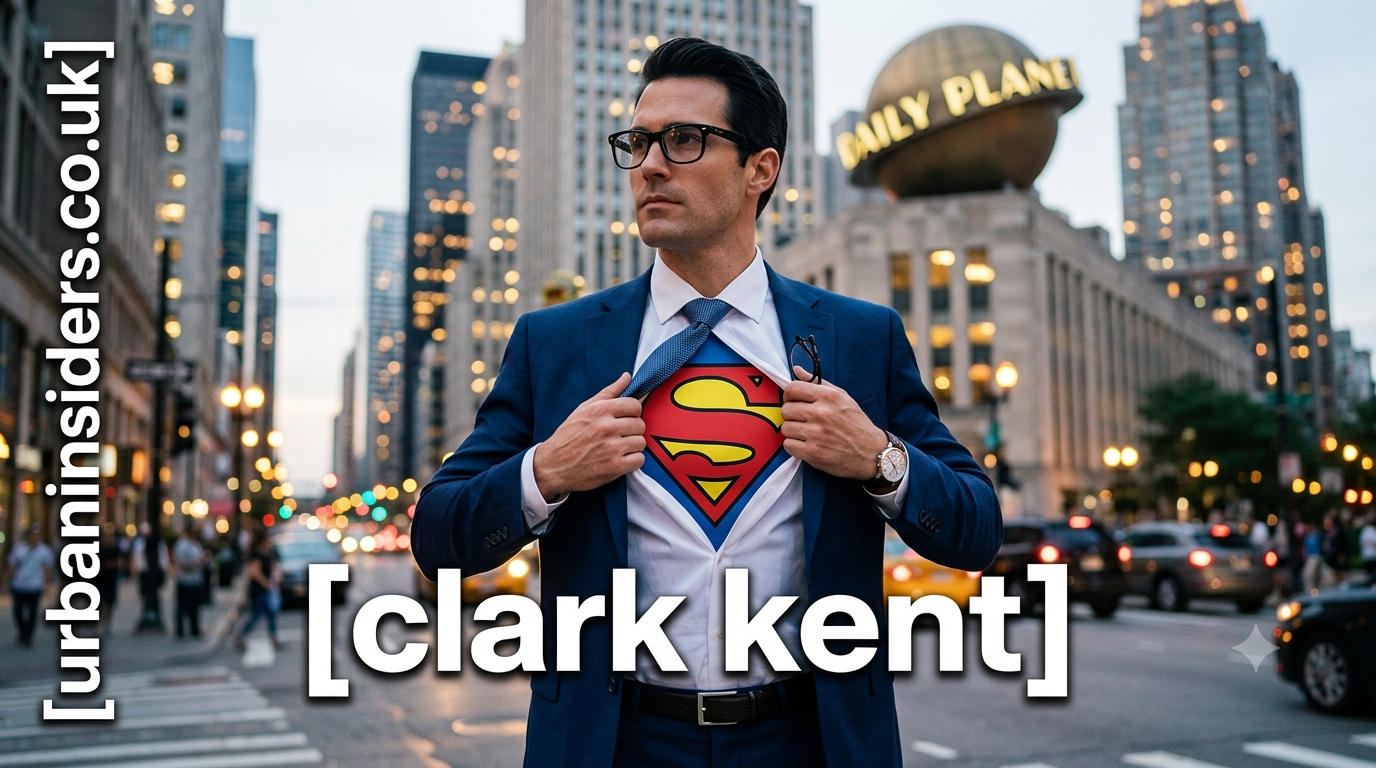
Most people know the twist before they ever read a page or watch a scene: Clark Kent and Superman are the same person. There’s no mystery left to protect. And yet the character keeps working, decade after decade, across comics, cartoons, and movies. That’s worth pausing on, because it says something about why Clark Kent isn’t just a costume change — he’s the actual point of the story.
This piece breaks down who Clark Kent is, where he came from, why the “mild-mannered reporter” routine still holds up, and how different writers and actors have shaped him over the years.
What Is Clark Kent, Exactly?
Clark Kent is the human identity of Superman, created by writer Jerry Siegel and artist Joe Shuster. He first appeared in Action Comics #1 in 1938, and the basic setup has stayed remarkably stable since then: an infant sent to Earth from the dying planet Krypton, raised by a farming couple in Kansas, who grows up to work as a journalist while secretly using his powers to help people.
The name itself borrows from two 1930s film stars — Clark Gable and Kent Taylor — which tells you something about how consciously constructed the character was from day one. He wasn’t meant to be an accident. He was built to feel like an ordinary guy you’d recognize from the movies or the newsroom next door.
What makes Clark Kent distinct from most superhero alter egos is the order of operations. Batman is Bruce Wayne’s mask. Clark Kent is Superman’s mask. The “real” identity, in terms of who the character fundamentally is, leans toward the farm boy from Kansas — not the alien who can lift a building.
Read more:Who Is Matt Damon Wife? Everything to Know About Luciana Barroso
Why Clark Kent Matters
It would be easy to treat Clark Kent as filler between action scenes. That’s a mistake a lot of adaptations have made, and it usually shows in how flat the story feels.
The character matters because he’s the mechanism that makes Superman’s power bearable to watch. A being who can move planets and never gets hurt has no real stakes unless he also has a life that can be disrupted — deadlines he can miss, a boss who’s annoyed with him, a coworker who doesn’t take him seriously. Clark Kent gives Superman something to lose that isn’t physical.
He also reframes what “heroism” looks like. Superman gets the headlines, but Clark Kent is the one who notices the story nobody else is covering, who sits with a source until they trust him, who shows up to work exhausted because he spent the night in Metropolis stopping a fire. The reporter job isn’t a throwaway detail — it’s doing the same job as the cape, just with a notebook instead of fists.
Key Traits That Define the Character
He’s deliberately unremarkable. Writers have described Clark as slightly clumsy, a bit forgetful, and easy to overlook in a room — traits that work as camouflage precisely because Superman is the opposite of all three.
He’s genuinely kind, not performatively kind. Unlike heroes who are gruff loners with a soft center, Clark’s default setting is decency. He holds doors, he listens, he checks on people. It’s not a twist; it’s the baseline.
He’s curious in a journalist’s way. The reporter job isn’t incidental — Clark asks questions, follows leads, and cares about getting facts right. That instinct carries over into how Superman operates: he tends to understand a situation before he acts on it.
He struggles with the split. In stronger stories, Clark isn’t perfectly at peace with living two lives. There’s tension in constantly downplaying himself, in the small lies to Lois Lane or his editor, in never fully belonging to either the Kent farm or Krypton.

How Clark Kent’s Story Has Evolved
The character hasn’t stood still, and it’s worth knowing the broad shifts if you’re trying to understand why different versions feel so different.
Golden and Silver Age (1938–1970s): Clark was closer to comic relief — a bumbling foil to the confident Superman. The disguise leaned heavily on slapstick.
Post-Crisis reboot (1986, John Byrne’s Man of Steel): This is the version most modern takes build on. Clark Kent became the primary personality, with Superman as the role he puts on. He was a star college quarterback, not a klutz, and his Kansas upbringing got far more attention.
Modern comics and film: Recent stories tend to treat Clark and Superman as fully integrated — less about hiding, more about a man who happens to have two jobs. Movies like Man of Steel (2013) leaned into the alien-outsider angle, while Superman (2025) pulled back toward a warmer, more optimistic version closer to the character’s earliest intentions.
On screen: Christopher Reeve’s 1978 performance set the template many people still picture — an actual physical difference in posture and voice between Clark and Superman. Tyler Hoechlin’s take in Superman & Lois leaned into Clark as a father and small-town figure first. Each actor has had to answer the same question differently: how do you play “ordinary” when the audience knows exactly who’s underneath it?
Common Misconceptions
“Nobody would really fall for the glasses.” This gets brought up constantly, and writers have addressed it directly over the years — the explanation usually isn’t about the glasses alone. It’s posture, voice, body language, and the simple psychological trick that people don’t expect a mild reporter to be the most powerful being on the planet. Comics writer Grant Morrison summed up the logic once as ordinary people simply not looking hard enough at what’s right in front of them, because it doesn’t occur to them to.
“Clark Kent is just Superman’s boring alter ego.” This undersells the character. In the strongest stories, Clark isn’t a disguise so much as the actual center of the story, with Superman as the extension of him — not the reverse.
“He’s always been a mild-mannered pushover.” That description technically comes from the character’s original narration, but it’s been softened or dropped in most modern portrayals, where Clark is written as quietly confident rather than timid.
Practical Notes for Writers, Fans, and Cosplayers
If you’re studying the character for a creative project, a school essay, or a cosplay build, a few things are worth keeping in mind:
- Nail the contrast, not the costume. What makes Clark work is the difference in energy between him and Superman — shoulders slightly hunched, voice pitched a touch higher, less eye contact. The glasses do less work than people assume.
- Don’t skip the Kansas upbringing. Martha and Jonathan Kent’s influence is often the actual engine of Clark’s values. Leaving it out tends to make the character feel generic.
- Treat the reporter job as real work, not a costume change. Stories that show Clark actually reporting — chasing a source, missing a deadline — tend to land better than ones where the Daily Planet is just a backdrop.
- Be careful with tone. The character can tip into either extreme: too much of a boy scout reads as flat, too much brooding reads as out of character. The Superman most audiences respond to sits closer to hopeful than tortured.
Frequently Asked Questions
Is Clark Kent the real name or is Kal-El? Kal-El is his Kryptonian birth name. Clark Kent is the name given to him by his adoptive parents, Jonathan and Martha Kent, and it’s the identity he’s lived under since infancy — which is part of why most modern stories treat it as his “real” self.
Why does nobody recognize Superman as Clark Kent? The in-story explanation usually combines a physical disguise (glasses, posture, voice) with a psychological one: people aren’t primed to look for Superman in an ordinary setting, so they don’t examine Clark closely enough to notice.
Does Clark Kent have any powers when he’s “just” Clark? Yes. The powers aren’t switched off — Clark simply restrains and downplays them while in his Kent persona. He’s the same being underneath the suit at all times.
What is Clark Kent’s job at the Daily Planet? He works as a reporter, a role established from the character’s earliest appearances and kept consistent across nearly every version of the story since.
Who are Clark Kent’s parents? His biological parents are Jor-El and Lara of Krypton. He was raised on Earth by Jonathan and Martha Kent, whose values shape most of his character.
Is Clark Kent married to Lois Lane? In current mainline comics continuity, yes — Clark and Lois are married with a son, Jonathan “Jon” Kent. Film and TV versions vary in how far they take this storyline.
Final Thoughts
Clark Kent works because he was never meant to be the throwaway half of the story. He’s the version of Superman that has to deal with rent, deadlines, and awkward small talk — the version that makes the powers mean something. Strip him out, and Superman becomes a special-effects reel. Keep him grounded, and you get a character that’s stuck around for close to ninety years for a reason.