
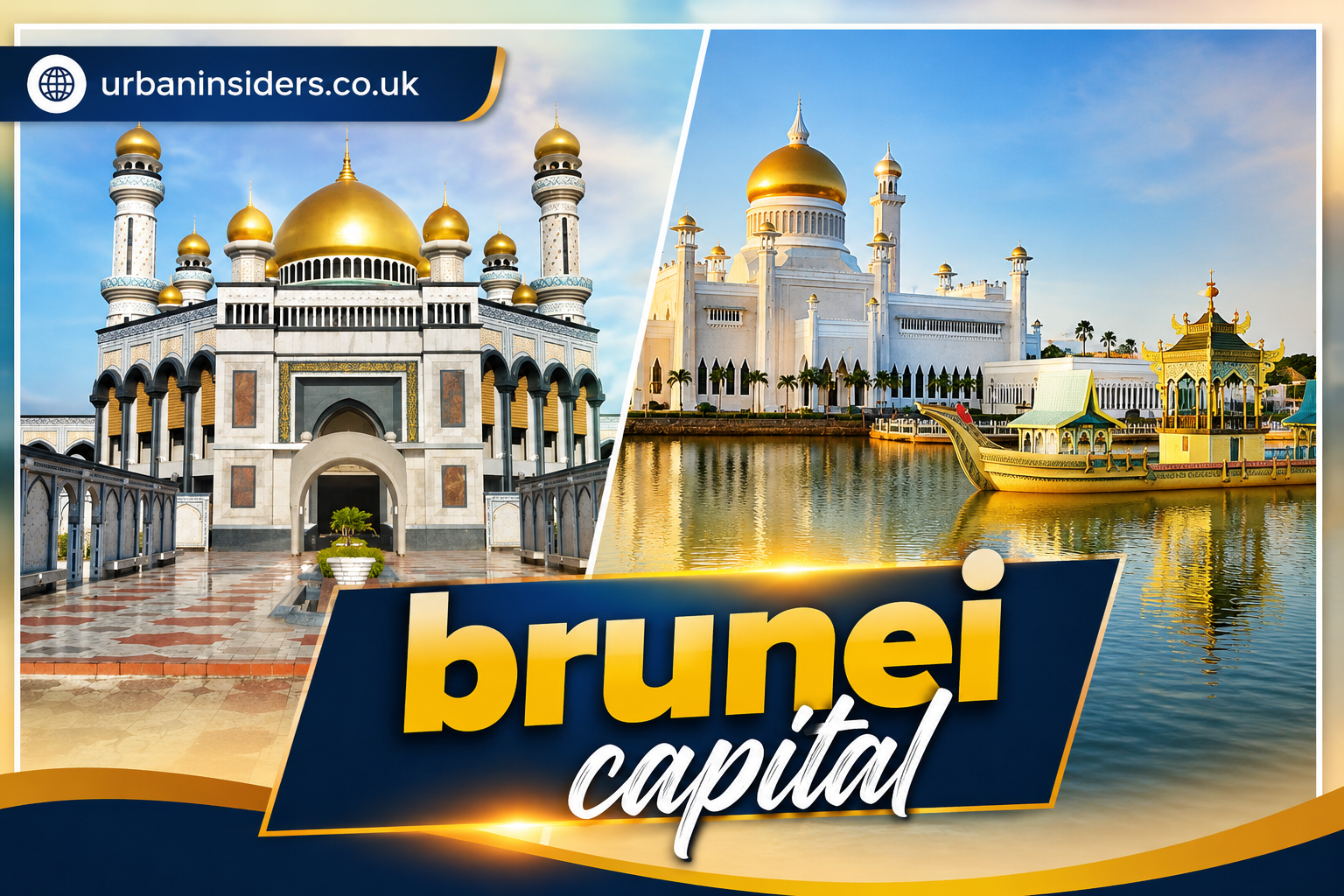
Brunei capital city is Bandar Seri Begawan, a compact and culturally rich city on the banks of the Brunei River. Often shortened to “Bandar” by locals, it is the political, cultural, and historical heart of Brunei Darussalam. The city combines Islamic architecture, royal heritage, traditional water villages, museums, markets, and a relaxed urban atmosphere.
For travelers, understanding the Brunei capital means looking beyond its role as an administrative center. Bandar Seri Begawan offers a window into Brunei’s history and identity, from the magnificent Omar ‘Ali Saifuddien Mosque to the centuries-old community of Kampong Ayer.
What Is the Capital of Brunei?

The capital of Brunei is Bandar Seri Begawan, located in the Brunei-Muara District on the northern part of the island of Borneo. Brunei itself occupies part of Borneo’s northwestern coast, with the South China Sea to the north. The country is surrounded on its landward side by Malaysia’s Sarawak state.
Bandar Seri Begawan serves as the country’s main center of government and administration. It is also where visitors encounter many of Brunei’s most recognizable landmarks, museums, religious sites, and cultural attractions. The official tourism authority describes the city as a place where history, heritage, and the Brunei River come together.
Read more: Jacob Elordi in Frankenstein Inside His Transformation Into Guillermo del Toro’s Creature
Where Is Bandar Seri Begawan Located?
Bandar Seri Begawan sits along the Brunei River, an important waterway that has played a major role in the development of Bruneian civilization. The river connects the modern capital with the historic water settlement of Kampong Ayer, creating a distinctive landscape in which urban streets and traditional waterways exist side by side.
The capital is part of Brunei-Muara, one of Brunei’s four districts. The city and surrounding district are particularly important for tourism because many of the country’s major cultural and historical attractions are concentrated in the area. This makes Bandar Seri Begawan a practical base for visitors interested in exploring Brunei’s heritage.
A Brief History of Brunei’s Capital
The story of Bandar Seri Begawan is closely connected with the Brunei River and Kampong Ayer. According to Brunei’s official tourism information, early settlements developed around the river, where access to water, food, and natural surroundings supported communities near what is now the capital. Over time, the area became central to the growth of Brunei’s civilization.
The modern capital also reflects Brunei’s more recent political history. Brunei became fully independent on 1 January 1984, and several important sites in the capital are associated with that transition. Taman Haji Sir Muda Omar ‘Ali Saifuddien, for example, is the location where independence was declared and continues to host major national and ceremonial events.
Why Bandar Seri Begawan Is Important to Brunei
Bandar Seri Begawan is more than simply the country’s administrative capital. It is a place where Brunei’s monarchy, Islamic traditions, Malay culture, and national history are particularly visible. Government buildings, royal institutions, mosques, museums, and historic neighborhoods all contribute to the city’s distinctive character.
The city also provides an accessible introduction to Brunei’s national identity. Brunei officially describes itself as a Malay Islamic Monarchy, or Melayu Islam Beraja, a philosophy that connects the country’s Malay heritage, Islamic faith, and monarchical system. Visitors can see aspects of this identity throughout the capital’s architecture, ceremonies, museums, and public spaces.
Omar ‘Ali Saifuddien Mosque
One of the most recognizable landmarks in Bandar Seri Begawan is the Omar ‘Ali Saifuddien Mosque. Located in the heart of the capital, the mosque is known for its golden dome, marble features, landscaped surroundings, and peaceful lagoon. It was completed in 1958 and named after the 28th Sultan of Brunei.
The mosque is particularly striking because of the way its architecture interacts with the surrounding landscape. A replica of a 16th-century royal barge sits on the lagoon, adding another reference to Brunei’s royal and Islamic heritage. For many visitors, the mosque provides one of the clearest visual introductions to the character of the capital.
Kampong Ayer and Life on the Water
Another defining attraction near the Brunei capital is Kampong Ayer, one of Southeast Asia’s largest water settlements. Built largely on stilts over the Brunei River, the community has a history stretching back more than a thousand years. Its waterways, wooden walkways, bridges, homes, and community facilities provide a very different perspective on urban life.
A boat ride on the Brunei River is one of the most memorable ways to experience the area. Visitors can also explore the Kampong Ayer Cultural and Tourism Gallery to gain more insight into the settlement’s history and traditions. The contrast between Kampong Ayer and the modern city streets of Bandar Seri Begawan is one of the capital’s most distinctive features.
Museums and Royal Heritage
Bandar Seri Begawan has several museums that help visitors understand Brunei’s history and royal traditions. The Royal Regalia Museum, located in the center of the capital, contains ceremonial objects connected with the monarchy, including royal regalia and other significant items. It is one of the key cultural attractions on the city’s walking-tour circuit.
The Brunei History Centre offers another perspective, focusing on the country’s historical heritage. Its displays include artifacts, ceremonial objects, antique weaponry, and maritime discoveries. Together, these institutions provide useful context for understanding how Brunei developed from a historic regional power into the modern independent state visitors see today.
Exploring the City on Foot
Although Bandar Seri Begawan is not a huge metropolitan city, its central area can be rewarding to explore on foot. Brunei Tourism has promoted walking routes that connect several historic landmarks, including the former Royal Customs and Excise Building, the Coronation Arch, Omar ‘Ali Saifuddien Mosque, Taman Haji Sir Muda Omar ‘Ali Saifuddien, the Secretariat Building, the Brunei History Centre, and the Royal Regalia.
Walking also makes it easier to appreciate details that can be missed from a vehicle. Historic buildings, public gardens, religious architecture, river views, and local commercial areas are relatively close together in the central part of the city. Visitors can combine sightseeing with stops at markets and cultural attractions for a fuller experience.
What Is the Capital of Brunei Like for Visitors?
Bandar Seri Begawan generally offers a calmer experience than the major Southeast Asian capitals that dominate international tourism. Its appeal comes less from a crowded skyline or large entertainment districts and more from its heritage, architecture, religious landmarks, river scenery, and relaxed pace.
Visitors should also remember that Brunei is an Islamic country with its own cultural expectations and customs. Respectful clothing and behavior are important, particularly when visiting mosques and other religious or culturally significant locations. Checking current visitor rules and opening times before visiting individual attractions is sensible because schedules can change.
Getting Around Bandar Seri Begawan
Visitors can explore parts of central Bandar Seri Begawan by walking, while taxis, private vehicles, and local transport options can be useful for attractions farther apart. Brunei Tourism also recommends Dart, a local ride-booking service, as a convenient option for travelers without access to a private car. Public buses are another option for getting around the city and surrounding areas.
The city is also well positioned for exploring attractions beyond its immediate center. For travelers with additional time, the surrounding Brunei-Muara District offers further cultural, historical, and recreational experiences. The Sultan Haji Omar ‘Ali Saifuddien Bridge also provides a major road connection toward Temburong and has become a notable feature of Brunei’s modern infrastructure.
When Is a Good Time to Explore the Brunei Capital?
Brunei has a humid tropical climate, so visitors should generally expect warm conditions and the possibility of rain throughout the year. The weather can influence outdoor activities such as walking tours, river trips, and sightseeing around the city.
Because of the tropical conditions, planning outdoor exploration for comfortable parts of the day can make a noticeable difference. Travelers should also check attraction-specific opening schedules before setting out. Some museums and cultural sites have particular weekly closures or shorter hours on certain days, making advance planning useful.
FAQs
What is the capital of Brunei?
The capital of Brunei Darussalam is Bandar Seri Begawan, commonly shortened to Bandar. It is located in the Brunei-Muara District along the Brunei River.
What is Bandar Seri Begawan famous for?
The city is particularly known for Omar ‘Ali Saifuddien Mosque, Kampong Ayer, royal heritage, museums, Islamic architecture, and its historic connection with the Brunei River.
Is Kampong Ayer in the capital?
Yes. Kampong Ayer is located in Bandar Seri Begawan along the Brunei River and is one of the city’s most distinctive cultural attractions.
Is Bandar Seri Begawan worth visiting?
For travelers interested in Southeast Asian history, Islamic architecture, royal heritage, traditional communities, and river-based culture, Bandar Seri Begawan offers a distinctive experience that differs considerably from larger regional capitals.
Conclusion
The Brunei capital, Bandar Seri Begawan, is a city where Brunei’s history and modern national identity meet. Its riverside setting, grand mosque, royal museums, historic buildings, and remarkable water settlement of Kampong Ayer make it much more than an administrative center.
For first-time visitors, the best way to understand the city is to experience several sides of it: walk through the historic center, admire Omar ‘Ali Saifuddien Mosque, explore royal and historical collections, and take time to see life along the Brunei River. Together, these experiences reveal why Bandar Seri Begawan remains the cultural and historical heart of Brunei Darussalam.